-leading a child in love
-cannot speak wisdoms too early
-to be patient, truly patient, through the foolishness
--
sometimes the right way to love someone isn't to speak a truth to them that they cannot yet understand; it is to comfort them to their whims, while occasionally challenging them to grow. perhaps that is love. perhaps this is God's design - to challenge humanity to rise out of our sin, discovering christ and falling away and discovering him again in new ways.
what beautiful swish of sacred words delicately pat this night-time sky
can these words ever last longer than a wash of my eyes, one night
how delicate and great and wise we see
what strength God has to love others well
truly divine
it really is between me and God - as I lean on Him in my relationships with others
for who else can possibly know me? certainly no human can like Him
I have been the young fool before others before
I still am, in some ways, as I learn new tasks about my days
that strength - that wisdom of knowing oneself well
that they may give to others how they give best
God, what strengths should I be turning to, to growing?
a poetic mind with soft spirit and churning thoughts that drizzle out papers and ideas
is this me? is this the path I will go down next?
and have you hidden this from me before because it was too early for me to know?
Sunday, September 16, 2018

Friday, April 20, 2018
sinusoidal action and thought
i always liked how you hid behind words. maybe it's because I was the same. it's like our secret, that we were both insane.
--
poetry is such a beautiful way to magnify the present, to bring it right up to your senses.
good reflection, for enjoyment
but keep forward with the action
action and thought: two in sinusoidal flow
--
I've learned plenty from others these past 2.5 years. The thoughtlessness of others, the desire to push forward with action rather than pause, meditate, enjoy the moment - so alien.
Or perhaps, I just didn't closely enough, and we actually were doing the same thing. It was just that our amplitude and frequency were different for our action-thought sin waves.
--
poetry is such a beautiful way to magnify the present, to bring it right up to your senses.
good reflection, for enjoyment
but keep forward with the action
action and thought: two in sinusoidal flow
--
I've learned plenty from others these past 2.5 years. The thoughtlessness of others, the desire to push forward with action rather than pause, meditate, enjoy the moment - so alien.
Or perhaps, I just didn't closely enough, and we actually were doing the same thing. It was just that our amplitude and frequency were different for our action-thought sin waves.
Monday, December 18, 2017
skills are trees; the forest is experience, enjoyment, and service
It's such a specific skill to recognize food allergic reactions. It's one that you can train only after such disciplined exposure in medical school, residency, etc.
...specific like all these abilities you have been pondering. Chess is so specific, all about this specific board set with such specific rules. Yet you see a beauty to its craft, its tactics, its strategy.
Software engineering, too - seeing code patterns, navigating web interfaces, searching for info. That description may already be too broad: the broad skill of adapting, learning new things, reading carefully and applying astutely. But the specific skill could be using your company's tools proficiently... engineering. Management of engineers.
Yet here we all are - humanity! Each acquiring different skills, different experience that one can then use to serve others. We must be aware of our skills, experiences, and tendencies, and translate them to serve others.
Perhaps you shouldn't be honing in on specific skills. Maybe it's making you miss the forest for the trees. *The big picture is simply to experience and enjoy life while serving others with your abilities, which come from your tendencies and experience.*
Give to others in your own special way. Be comfortable and love that.
Sunday, December 17, 2017
chess tactics: direct action to the one true goal
I used to play chess as though I had infinite time. I would prefer to trade pieces, chip away the board until the opponent was entirely stripped of everything except a king and maybe a few pawns. And then I would close in and checkmate.
Yet, chess tactical puzzles taught me that I had been ignoring more direct approaches to the goal. You can checkmate far earlier, and there's a beauty to nailing down the king with a board so full of pieces. It's like you didn't waste your time bumbling about, but you dove right to the solution.
It reminds me of Ender tunneling to the end goal in Ender's Game, strictly adhering to the bare minimum of the rules to win.
Just go for the true target, and never lose focus on that. Nail that down.
This mentality applies to so many things in life - shooting for the true pursuit, and not letting distractions make you aimlessly move about. In my software engineering work, I could do so many things to further analyze an experiment, to try new features, to implement new things - but which of those are truly in pursuit of the main goal?
All steps should clearly be taken in pursuit of the main goal.
--
color complexes are also elegant - seeing the pattern of colored squares that are weak in the enemy, and exploiting that weakness. advancing your queen to a protected spot to further take control of a territory feels so satisfying.
Yet, chess tactical puzzles taught me that I had been ignoring more direct approaches to the goal. You can checkmate far earlier, and there's a beauty to nailing down the king with a board so full of pieces. It's like you didn't waste your time bumbling about, but you dove right to the solution.
It reminds me of Ender tunneling to the end goal in Ender's Game, strictly adhering to the bare minimum of the rules to win.
Just go for the true target, and never lose focus on that. Nail that down.
This mentality applies to so many things in life - shooting for the true pursuit, and not letting distractions make you aimlessly move about. In my software engineering work, I could do so many things to further analyze an experiment, to try new features, to implement new things - but which of those are truly in pursuit of the main goal?
All steps should clearly be taken in pursuit of the main goal.
--
color complexes are also elegant - seeing the pattern of colored squares that are weak in the enemy, and exploiting that weakness. advancing your queen to a protected spot to further take control of a territory feels so satisfying.
mapping of a person's abilities
a mapping of all a person's potential abilities
why is it that some people, who seem to acquire so much talent, can yet seem so immature?
as though they still lack something that others, who have less "talent" you may say or diversity of ability, seem to have.
it's something about generosity. about the willingness to sacrifice yourself for others. perhaps that is the trait that differentiates. sacrificing time, which could be spent building up your own ability for your own glory. it changes when you're more intertwined in community and relationships - you now build up ability to serve the other person and others around you. and you may give up time to acquire your new skillsets. (but you can "sacrifice" your time joyfully - when you see the beautiful fruit it brings.)
a father, a mother, gives up so much to build up children.
a child develops and voraciously acquires more and more ability - but when do they start giving back?
what message am i trying to send here.
--
the joy of setting goals, of setting a direction. it's like declaring before a crew you're the captain of, "we are going to this island to find this treasure!" it's the wonder of the pursuit, not the destination, that matters.
he knows not where he's going
for the ocean will decide
it's not the destination
it's the glory of the ride
why is it that some people, who seem to acquire so much talent, can yet seem so immature?
as though they still lack something that others, who have less "talent" you may say or diversity of ability, seem to have.
it's something about generosity. about the willingness to sacrifice yourself for others. perhaps that is the trait that differentiates. sacrificing time, which could be spent building up your own ability for your own glory. it changes when you're more intertwined in community and relationships - you now build up ability to serve the other person and others around you. and you may give up time to acquire your new skillsets. (but you can "sacrifice" your time joyfully - when you see the beautiful fruit it brings.)
a father, a mother, gives up so much to build up children.
a child develops and voraciously acquires more and more ability - but when do they start giving back?
what message am i trying to send here.
--
the joy of setting goals, of setting a direction. it's like declaring before a crew you're the captain of, "we are going to this island to find this treasure!" it's the wonder of the pursuit, not the destination, that matters.
he knows not where he's going
for the ocean will decide
it's not the destination
it's the glory of the ride
Saturday, December 16, 2017
complex organizations
Navigating a complex organization is like sailing the sea - so vast, so deep, and one person could never plumb its depths completely or sail everywhere. But overtime, riding the waves, you can get a sense of how the currents work - the forces at play - and you can direct ships along it to serve people. Over time, you can create true utility out of complexity.
Sunday, December 10, 2017
two kinds of trust
If you've ever had a dispute around trust, it may help to recognize there are at least two types.
1) Trust in a person's good intentions
2) Trust in a person's ability
You must trust in a person's good intentions before you can love them. This is the traditional notion of trust in relationships.
However, you do not have to trust in someone's ability to do something to love them.
For example, if a child desires to drive your car, you can distrust their ability to drive and just drive for them out of continued love for them (or fear for their safety).
Another example: If someone exclaims in outrage at you, "You're not trusting me!" you could be trusting in that they have good intentions, but not trusting in that what they are doing is best for the circumstances. So you could explain this distinction - that you do trust their good intentions, but simply are doubtful that their methodology is the best avenue available.
Recognizing these two kinds of trust can help resolve disputes around trust issues. Once again, this is all about creating the right vocabulary so people can communicate better.
1) Trust in a person's good intentions
2) Trust in a person's ability
You must trust in a person's good intentions before you can love them. This is the traditional notion of trust in relationships.
However, you do not have to trust in someone's ability to do something to love them.
For example, if a child desires to drive your car, you can distrust their ability to drive and just drive for them out of continued love for them (or fear for their safety).
Another example: If someone exclaims in outrage at you, "You're not trusting me!" you could be trusting in that they have good intentions, but not trusting in that what they are doing is best for the circumstances. So you could explain this distinction - that you do trust their good intentions, but simply are doubtful that their methodology is the best avenue available.
Recognizing these two kinds of trust can help resolve disputes around trust issues. Once again, this is all about creating the right vocabulary so people can communicate better.
Saturday, October 8, 2016
pals
here are 4 broad dimensions
on which all life challenges and directions
can be molded in a move
to grow the self, improve
problem solving
acquiring rules efficiently
leadership
selflessness
on which all life challenges and directions
can be molded in a move
to grow the self, improve
problem solving
acquiring rules efficiently
leadership
selflessness
Sunday, August 21, 2016
revisiting
all along, the source of information was deluded. the source was not sound.
and revisiting, the writings here are as though by a stranger, when they were once me.
and revisiting, the writings here are as though by a stranger, when they were once me.
Monday, February 15, 2016
the lesson is learned; let the crate sink
jill and joe fought over opening the crate; they knew all the darkness inside, all the fear and terror, the troubles of the world, the pain
step in, create space, back away and think first; together we sat down and held hands around it and asked, Why open? What lesson is there to be learned?
in front of the crate, we already had the lesson there, on a thin slip of paper:
do not trust genius, narcissism, charm; great accomplishment can give rise to pride, the worst of the seven sins. pride can take a person down, and many others with that person.
so we have the lesson. it is there. there is no need to keep the crate now. let us drop it, let it sink to the bottom.
I command jill and joe to carry the crate to the edge of the ship, no strings attached. It drops into the ocean with a splash, white wash flying up, but then gone. briefly we see its dark brown exterior sink deeper, deeper... into blackness. it'll be at the bottom of the sea, along with probably thousands of other crates, many of which far larger. the sea is ridden with evil crates from the world, horror stories, but we take the slip of paper from it - the lessons - and let these crates fade away to nothingness.
this one is gone.
there may be small bubbles that come from bubble, little slips of paper that look tempting to grab. we should fish them gently, but not dive deeper into the realms below, because only drowning can be found there.
fish carefully; create space, lots of space, at any site of faint bubbles arising; do not rush, do not be overeager; be patient, gentle; this is something jill should not jump in for; just gently notice the bubbles coming up, let them sit at the surface for a while; only later on, will a slip of paper bubble up to join, and that small thing should be snagged gently, barely scraping the surface of the water
may we return to guiding our ship, navigating these waters, finding peaceful views of glaciers, green forests, beautiful land, beautiful sky
step in, create space, back away and think first; together we sat down and held hands around it and asked, Why open? What lesson is there to be learned?
in front of the crate, we already had the lesson there, on a thin slip of paper:
do not trust genius, narcissism, charm; great accomplishment can give rise to pride, the worst of the seven sins. pride can take a person down, and many others with that person.
so we have the lesson. it is there. there is no need to keep the crate now. let us drop it, let it sink to the bottom.
I command jill and joe to carry the crate to the edge of the ship, no strings attached. It drops into the ocean with a splash, white wash flying up, but then gone. briefly we see its dark brown exterior sink deeper, deeper... into blackness. it'll be at the bottom of the sea, along with probably thousands of other crates, many of which far larger. the sea is ridden with evil crates from the world, horror stories, but we take the slip of paper from it - the lessons - and let these crates fade away to nothingness.
this one is gone.
there may be small bubbles that come from bubble, little slips of paper that look tempting to grab. we should fish them gently, but not dive deeper into the realms below, because only drowning can be found there.
fish carefully; create space, lots of space, at any site of faint bubbles arising; do not rush, do not be overeager; be patient, gentle; this is something jill should not jump in for; just gently notice the bubbles coming up, let them sit at the surface for a while; only later on, will a slip of paper bubble up to join, and that small thing should be snagged gently, barely scraping the surface of the water
may we return to guiding our ship, navigating these waters, finding peaceful views of glaciers, green forests, beautiful land, beautiful sky
a mind divided - captain of the ship: jill and joe people
people call me one name, generally
(other languages aside)
but in my head, there are actually multiple
d is the captain of the ship, the one who steers and navigates the storms, calls out when he spots land; draws cheers, encouragement; gives rise to celebration
then the crew members, none of whom act with space between stimulus and response:
jill people, the emotional, the irrational, acting through spontaneity; these people have instincts, can sense emotions; are eager to take action quickly
joe people, the stolid, quiet, hard workers; those who can be depended on for robotic tasks, but who focus too much on conscious logical decision-making, not enough on gut feeling, often deliberating too much
d should balance his crew members, draw from the behavior of the crowd, and decide how to navigate the waters
jill people and joe people
it's about balancing intuition with reason, and keeping plenty of space between stimulus and response
(other languages aside)
but in my head, there are actually multiple
d is the captain of the ship, the one who steers and navigates the storms, calls out when he spots land; draws cheers, encouragement; gives rise to celebration
then the crew members, none of whom act with space between stimulus and response:
jill people, the emotional, the irrational, acting through spontaneity; these people have instincts, can sense emotions; are eager to take action quickly
joe people, the stolid, quiet, hard workers; those who can be depended on for robotic tasks, but who focus too much on conscious logical decision-making, not enough on gut feeling, often deliberating too much
d should balance his crew members, draw from the behavior of the crowd, and decide how to navigate the waters
jill people and joe people
it's about balancing intuition with reason, and keeping plenty of space between stimulus and response
Monday, March 30, 2015
shroud
A shadow of a portrait that I once held on the wall
People still stop and admire, rest their chins in their hands and thoughtfully smile
But I have since took down the frame
And let the dust settle on it from afar
An occasional smile, glance, eye contact
But usually her hair shrouds her queenly image
a sliver of brilliance; a whole history of accomplishment hidden
People still stop and admire, rest their chins in their hands and thoughtfully smile
But I have since took down the frame
And let the dust settle on it from afar
An occasional smile, glance, eye contact
But usually her hair shrouds her queenly image
a sliver of brilliance; a whole history of accomplishment hidden
Monday, February 16, 2015
wispy conversation. defeat.
some people we talk to, the words just vanish into thin air. wisps. as though the conversation never even happened. no substance, no real buildup in getting to know each other, no consequence.
--
defeated. but in defeat, there is great simplicity.
Monday, December 8, 2014
Basic audio engineering - USB-MIDI cable, y adapter, stereo/mono/TRS/TS understanding
Background
I had decided to purchase a USB-MIDI cable online, and I was delighted to find a cheap one costing < $5.00: http://www.amazon.com/gp/product/B001LJUVO4/ref=oh_aui_detailpage_o00_s00?ie=UTF8&psc=1. When it came, no setup was required other than plugging it in. It seemed to work well, transmitting notes from my keyboard (a Yamaha P95-B) to GarageBand.
But the problem came when I depressed the pedal: The software did sustain properly, but it also registered a blatant E note. The E note is unacceptable for me because I use the pedal often when I play piano, and it completely interferes with whatever I'm playing.
Consequently, I searched online for a solution. It seemed many people had had this issue: "Pedal plays an E???" (Apple discussion thread). Unfortunately, there was no clear answer. When I search for solutions online, I try to find multiple sources that describe the same answer - not only to get multiple perspectives for more information, but also for higher confidence in the solution.
Some people in stores suggest the problem is on the software's side, or the keyboard's side, or the pedal's side. This is possible, but in this specific case of the pedal playing an E note but also doing the sustain properly, I have found the issue to be in the specific cable.
One answer in the Apple discussion at https://discussions.apple.com/thread/3122897?tstart=0 describes that the cable is the problem, too:
Well, my problem has been solved.
I coughed up AUD$49 and bought a branded USB-to-MIDI cable and the sustain problem has disappeared.
But there's no explanation for why a more expensive MIDI-USB cable might solve the issue for people in general. So I called Yamaha to ask about the keyboard, and see if it was truly the keyboard's problem or the cable or something else. This is what I learned:
To set up proprietary MIDI cables, you must ensure your computer has the proper drivers; if not, go through an install process to obtain them. For Mac, that amounts to simply downloading the right driver from this site: http://download.yamaha.com/search/detail/?site=usa.yamaha.com&language=en&category_id1=16277&category_id2=16279&category_id3=16298&product_id=107905&asset_file_language=EN&asset_id=57163. He said that the "UX16 USB MIDI driver" would work for me.
In summary, the problem was that the cheap cable that I had ordered lacked the proper driver support to interpret the pedal properly. According to the Yamaha support person, proprietary MIDI cables have proper support for these drivers, so buying a proprietary MIDI cable, which is more expensive, and then downloading the right driver on your computer is likely to solve the issue.
Solution
Basically, there are 2 kinds of MIDI cables: "class compliant" and "proprietary." Class compliant are the cheaper ones, typically $3-15. These can work for basic use, but they lack support for the appropriate drivers, so they may behave erratically, playing arbitrary notes or not registering sounds at all. Proprietary ones are more expensive, usually >$40. These support the appropriate drivers.To set up proprietary MIDI cables, you must ensure your computer has the proper drivers; if not, go through an install process to obtain them. For Mac, that amounts to simply downloading the right driver from this site: http://download.yamaha.com/search/detail/?site=usa.yamaha.com&language=en&category_id1=16277&category_id2=16279&category_id3=16298&product_id=107905&asset_file_language=EN&asset_id=57163. He said that the "UX16 USB MIDI driver" would work for me.
In summary, the problem was that the cheap cable that I had ordered lacked the proper driver support to interpret the pedal properly. According to the Yamaha support person, proprietary MIDI cables have proper support for these drivers, so buying a proprietary MIDI cable, which is more expensive, and then downloading the right driver on your computer is likely to solve the issue.
Why get a MIDI-USB cable to begin with?
My friend on the phone was of the talkative type, and he went into much more detail than I had anticipated. I'm grateful he did so because he actually helped me solve a bigger issue in my plan to record better music with my keyboard.
The whole reason I wanted a MIDI-USB cable was to record my keyboard playing more precisely. However, MIDI-USB cables don't transmit sound; they just play an existing sound on the computer in the GarageBand or Logic Pro library. The quality of the sound file may be better depending on the library of sounds available, so Logic Pro's library may sound better than GarageBand's library. But the point is that since no sound is transmitted through the cable, the nuances in piano playing are lost - you know, that expressive musician stuff. Granted, MIDI provides lots of benefits. The notes are editable in digital audio workstations (DAW) like Logic Pro, and you can change the instruments easily after recording. But for me, the nuances of music are more valuable, and I intend to record songs in one go and with minimal editing with a DAW anyway.
The whole reason I wanted a MIDI-USB cable was to record my keyboard playing more precisely. However, MIDI-USB cables don't transmit sound; they just play an existing sound on the computer in the GarageBand or Logic Pro library. The quality of the sound file may be better depending on the library of sounds available, so Logic Pro's library may sound better than GarageBand's library. But the point is that since no sound is transmitted through the cable, the nuances in piano playing are lost - you know, that expressive musician stuff. Granted, MIDI provides lots of benefits. The notes are editable in digital audio workstations (DAW) like Logic Pro, and you can change the instruments easily after recording. But for me, the nuances of music are more valuable, and I intend to record songs in one go and with minimal editing with a DAW anyway.
Understanding terminology
After explaining that I have a Scarlett 2i2 interface by Focusrite (http://us.focusrite.com/usb-audio-interfaces/scarlett-2i2), which accepts 2 inputs, he gave me this recommendation:To keep nuances of the keyboard, I should get a Y-cable. Specifically: "a Y adapter/cable with a stereo
- male refers to the pointed end of a cable; female refers to the hole/receiving end of the cable.
- 3.5mm (about 1/8 inch) is the common size for plugs into laptops and mp3 players. Think Apple earbuds or the typical headphone jack of a laptop - that's 3.5mm. 1/4 inch is the larger size for lots of audio equipment.
- So, by "miniature" he probably meant 3.5mm (1/8 inch), since 1/4 inch is probably the standard among audio engineering.
- I had told him I had a way to connect my regular headphones to my keyboard, so this is probably why he said "miniature". But my method requires using a converter from a 3.5mm female (F) to a 1/4 inch male (M). So, getting a 1/4 inch on both sides for the cable works better because then I don't have to use the converter.
- The converter is like this Hosa GPM 3.5mm TRS Adaptor.
- There are two types of sound systems: mono and stereo.
- From http://www.diffen.com/difference/Mono_vs_Stereo:
- Stereo (or Stereophonic sound) is the reproduction of sound using two or more independent audio channels in a way that creates the impression of sound heard from various directions, as in natural hearing.
- Mono (Monaural or monophonic sound reproduction) has audio in a single channel.
- Since stereo reproduces sound in 2 independent channels, it makes sense that the y-adapter splits off - the end with one part is the stereo side, and the end with two parts is the mono side.
- You can differentiate Stereo and Mono by looking at the number of stripes on the metal part. The stripes are insulation; the metal contact bands are the channels, with one extra for ground. So 2 metal bands means mono, and 3 metal bands means stereo. This explains those TS/TRS abbreviations we see on lots of cables/converters.
- TRS = tip ring sleeve = names of 3 metal parts = stereo
- TS = tip sleeve = names of 2 metal parts = mono
Finally, this is the cable I ended up ordering: http://www.amazon.com/Hosa-Cable-STP203-Dual-Insert/dp/B000068O1P/ref=cm_cr_pr_product_top/190-6296940-4917419. You can see the metal bands right in the picture.
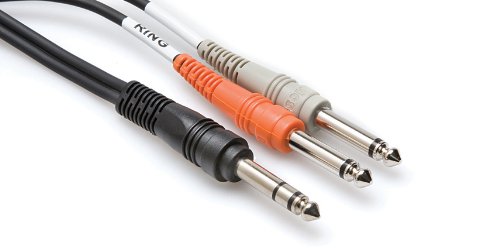
The 1/4 inch stereo side fits into my Yamaha P95-B's headphone jack, and the two 1/4 inch mono sides fit into my Scarlett 2i2 interface's two inputs. They work great.
The 1/4 inch stereo side fits into my Yamaha P95-B's headphone jack, and the two 1/4 inch mono sides fit into my Scarlett 2i2 interface's two inputs. They work great.
Diagram of how to connect
(Scarlett 2i2 Interface here)
Mono 1/4 inch male
Input 1 Input 2 - make sure to switch both to *Line input mode!*
\ /
\ /
----------
|
Stereo miniature male
(Keyboard here)
Then I can put headphones into the Scarlett and listen to myself play as I record.
Thursday, October 2, 2014
proximity, possibility; throwing vases at windows
the problem is the proximity and possibility.
we throw vases at windows to see which breaks first. do I create a way out, or merely shatter my inner art?
we throw vases at windows to see which breaks first. do I create a way out, or merely shatter my inner art?
--
this angst is wreaking havoc. the walls must be talking, the ceiling wagging a finger, the floor holding me up so I don't fall any further.
the human mind is not ready for this crazy burst of technology around us. our brains do not have the capacity to handle what our hands create. we no longer use handcuffs to lock up criminals, and tying our hands up makes no difference because they have built a thousand things to set them free.
isolation is a tower you have to climb to see the fruits at the top; but when you get to the top, do you actually want to look down? you just look into the horizon, the beauty of the skies around you.
Thursday, September 18, 2014
heartstrings and infinity
If you ever get to infinity
You will find me there
For tomorrow I will climb
The elementary stair.
You will find me there
For tomorrow I will climb
The elementary stair.
I will climb to the very top
Open up the door
Look at all the ages
Lying on the floor.
Open up the door
Look at all the ages
Lying on the floor.
-One Mind
--
Humans are naturally more responsive to physical phenomena than abstract phenomena. For example, children acquire language far better if they experience conversation from other human beings in person versus on television. Similarly, physical interaction with writing and paper tends to feel more satisfying for many, as many people report. [Reference.] Musical instruments capture a physical appreciation as well. There is something more satisfying about interacting with a mechanical device, such as a string instrument, with bare hands. Granted, some may feel that keyboards are more versatile than real pianos because of the possibility of combining a variety of sounds, such as the regular piano sound with strings or vocals. It becomes questionable what constitutes the boundary between mechanical/technological and not.
--
you tie my heartstrings around my wrists and hang me from the very stars I gaze at; then you pluck the strings with your tantalizing guitar picks, stealing melodies from my memories and casting them into the void. but I find a way to bring them back, to reel them in and retie the bow at my heart, and fire arrows of solitude stone dipped in choir music at your calloused hands
Saturday, August 30, 2014
143 feel, fall, conclude
those who have this close sensitivity to the world stand apart from the cold, unthinking, shielded ways of others; it's the difference of a recluse and a social frequenter - those who feel in quiet times, let moments seep by, and those who cling to the external world's praises and shouts. a strength and a weakness, this sensitivity. much more a weakness in these times when I deal with the odd opacity of those around me, the strange sense that there's something more there, yet teasingly let in only to be declined.
when I see something in the distance, I like to believe that I can feel that object there, feel the armies of clouds floating as I fly high above, feel the armchair rocking as I depart it at the airport, feel my momentum swaying the world behind me in my footsteps.
this here is my greatest strength and my greatest weakness. I wonder who can appreciate that.
this chapter has concluded though. I have tried to turn the page, and I think new words are about to meet my eyes. the problem is that my fingers are restless and sometimes want to turn back and glance at those twirling words of what happened and develop theories around them - but that is when your strength becomes your weakness: you overthink. not everyone has that order of thought, and when they don't and you deal with them, you end up deceiving yourself. remember, just hypotheses - nothing else. be objective.
hypotheses are not dreams.
--
mutual improvement with another would be fantastic.
--
why can't you just free me of this stockholm syndrome?
when I see something in the distance, I like to believe that I can feel that object there, feel the armies of clouds floating as I fly high above, feel the armchair rocking as I depart it at the airport, feel my momentum swaying the world behind me in my footsteps.
this here is my greatest strength and my greatest weakness. I wonder who can appreciate that.
this chapter has concluded though. I have tried to turn the page, and I think new words are about to meet my eyes. the problem is that my fingers are restless and sometimes want to turn back and glance at those twirling words of what happened and develop theories around them - but that is when your strength becomes your weakness: you overthink. not everyone has that order of thought, and when they don't and you deal with them, you end up deceiving yourself. remember, just hypotheses - nothing else. be objective.
hypotheses are not dreams.
--
mutual improvement with another would be fantastic.
--
why can't you just free me of this stockholm syndrome?
Tuesday, August 26, 2014
treasure mine
every time I see paragraphs of text; cabooses of words connected to form trains and trains of meaning; musical notes spread out across pages and pages – every time I see such things, I see a treasure mine of wealth, information, exploration; a mysterious depth as deep as space itself.
Tuesday, August 19, 2014
sensing
How do I truly internalize this wonderful summer? I feel as though I am squeezing a sponge to force out the oceans and oceans of happiness that had occurred, but I just can't quite squeeze hard enough; as though there is always more cold refreshing water to unleash, to seep out and hug my hands, to cleanse, to imbibe, to smell evaporate through your nostrils...
This feeling. The endless layers that keep appearing no matter how many times I peel the onion. The depth in each word that was spoken - I yearn for it to be felt; the ephemerality of each smile - I yearn for it to be collected into a wooden box, locked into my heart, with the key tossed off a cliff.
There is a force around me, a feeling from the mountains I see beyond the plane wing and clouds, the soft glow of light smeared by a paintbrush of God, stroking the horizon, painting a perfection that everyone else doesn't seem to yearn for; a touch of it, a smidge, is all my throat thirsts for, all my body aches for. I feel a mysterious force hovering about each object, each motion, each spin of a wheel along the cold concrete, each breath from the winds around the clouds I the distance. It tickles the edges of my senses, eliciting the tail end of a thread of my mind. I feel like I could swallow all oceans and still not fully quench this sensation at the edge of my senses.
Wednesday, August 13, 2014
the game
the investment game is like reaching into a murky pool of water to dig for riches. many people aren't willing to go deep enough after dressing up in such a nice tux for so many years. they cringe when their sleeves are drenched in a soggy cold mud; they wince when the water coldly kisses their knees and reaches up their thighs; they can't handle this seduction.
but there are others, the clever ones, who use fishing rods to let the bait draw in the gold. these patient others let rain clouds drift away while they strum their guitar to songbirds under the sun. it's a witty trick, a ritual. triumph and disaster are just different costumes worn by the same creature to them. and the beauty is that they can play along their lives with no stress as life goes on.
all it requires is picking the right pond.
Subscribe to:
Posts (Atom)